
Priorities
Thinning hair
A widening part, a receding hairline, or a thinning crown.
Pattern hair thinning develops gradually, as a part that widens, a hairline that recedes, or a crown that loses density. It affects both men and women, and we treat it at our Arlington Heights office.
We treat pattern thinning where the follicles are still alive. We don’t treat areas where the scalp has already gone smooth, but we can discuss other options with you.
What we'd want you to know
PRP helps thicken the hair you have, but it can't regrow a bald scalp
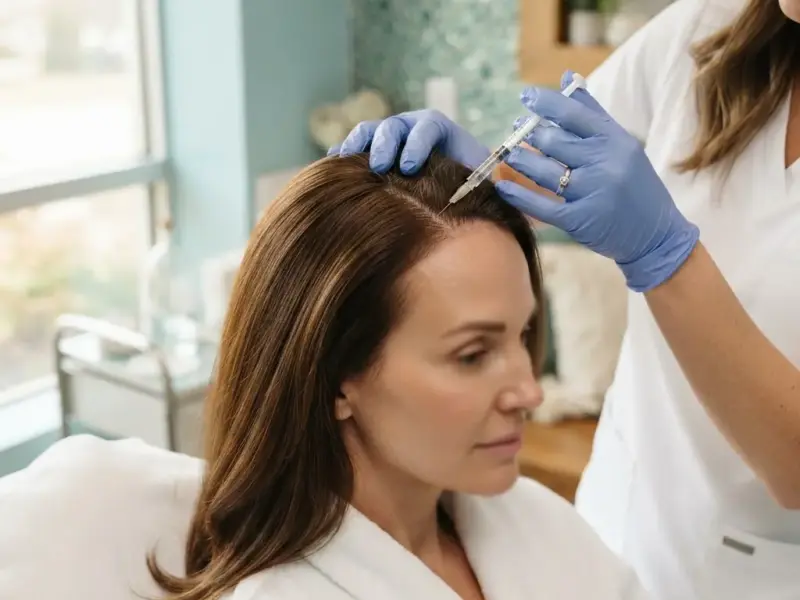
If you have thinning at the crown, the part, or the hairline with hair still growing there, we’d suggest PRP injections into the scalp. Our nurse practitioner draws your blood, spins it, and injects the platelet-rich layer into the thinning areas. You’ll start with three sessions, four to six weeks apart, then move to maintenance.
PRP works best alongside minoxidil or finasteride, not instead of them, because it doesn’t block the hormone that drives pattern loss. If you’re not using either, we’ll discuss whether one makes sense for you.
How we decide
We’ll part your hair and take a close look at the follicles. Fine, short hairs where thick ones used to be mean the follicle is alive and can be helped. Smooth, shiny scalp means the follicles are gone. We’ll also ask about sudden shedding, patchy loss, and scalp symptoms, because those are different conditions that need a dermatologist’s care.
For pattern thinning with living follicles, we’ll recommend PRP hair restoration. The evidence is real but modest. A 2023 systematic review of 27 controlled trials found PRP increased hair density by a mean of 25.6 hairs per square centimeter versus saline, and rated the evidence as low quality, per Blood Transfusion. PRP plus minoxidil beat either alone in a six-study meta-analysis, which is why we’ll usually plan PRP alongside medication. Individual results vary.
The first thing you’ll likely notice is slower shedding, usually by month two or three. Density changes were most often reported after the third month in the reviewed trials, so early progress can be hard to see. Without maintenance, the results fade, because the underlying process continues.
Your questions, answered
How many PRP sessions do I need for hair?
We’ll start you with three, four to six weeks apart. Then comes maintenance every three to six months in the first year, and once or twice a year after that. Our PRP schedule post walks through it visit by visit.
Can I drive back to work after?
Yes. Your scalp will be tender, and you can wear a cap afterward. Skip the gym and swimming for a day or two, and wait until the next day to wash your hair.
Does PRP work for women?
Yes, it can help with female pattern thinning, the diffuse widening of the part. A network meta-analysis found better responses in younger and female patients. Sudden or patchy loss in women is often something else, such as a thyroid or iron issue, so we’ll ask about recent lab work first.
Related treatments
From the clinic
Treatment guides · 5 min read
How many PRP treatments do you need for hair? The schedule we use
Plan on three sessions, then maintenance. Most people need three PRP sessions four to six weeks apart, then one maintenance session every three to six months,…
Compare and decide · 6 min read
PRP vs PRF for hair: does the upgrade matter?
PRF is PRP spun slower, with no anticoagulant, so it sets into a soft gel that releases growth factors more slowly. For hair, we use PRP…
Local · 6 min read
PRP hair restoration for Arlington Heights men: what happens, visit by visit
PRP hair restoration at our Arlington Heights office starts with three visits, four to six weeks apart. Each takes 45 to 60 minutes: a blood draw,…