
Clear sun spots and redness with light
IPL, intense pulsed light, uses filtered flashes of light to treat sun spots, redness, and small facial veins on lighter skin. It isn’t a laser, and for brown spots and redness it’s usually the better tool. Treated skin needs to stay untanned for two weeks on either side of a session, so IPL is best scheduled from late fall through early spring.
$350
body area, per session
At a glance
IPL photofacial- Appointment
- 20 to 40 minutes, cooling gel and eye shields
- Downtime
- Red for a few hours, then spots darken and flake over a week
- First results
- Spots lighten at 1 to 2 weeks, redness at 2 to 4 weeks
- Full results
- One month after the last session
- Sessions
- 3 to 5, about 3 to 4 weeks apart, October to April
- Cost
- From $350. About $88 per payment across 4
What to expect
What the appointment is like
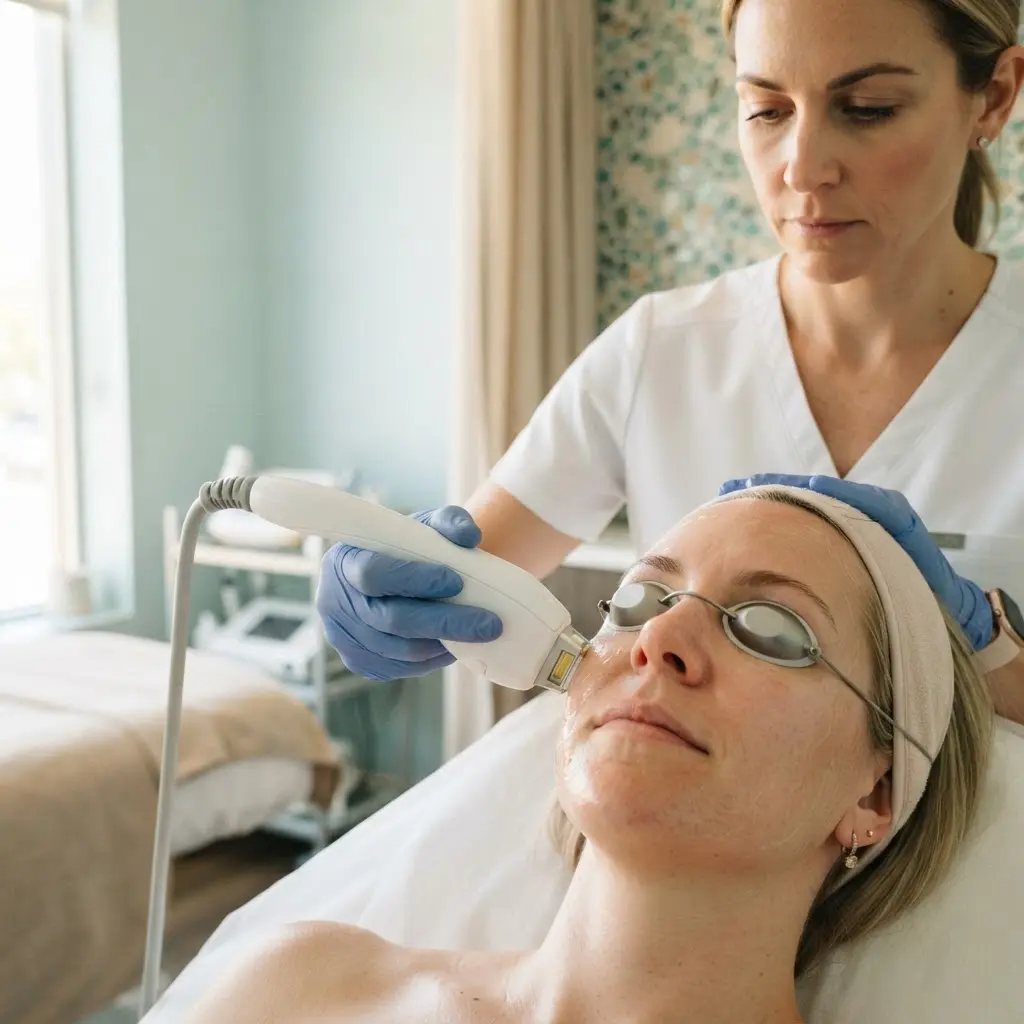
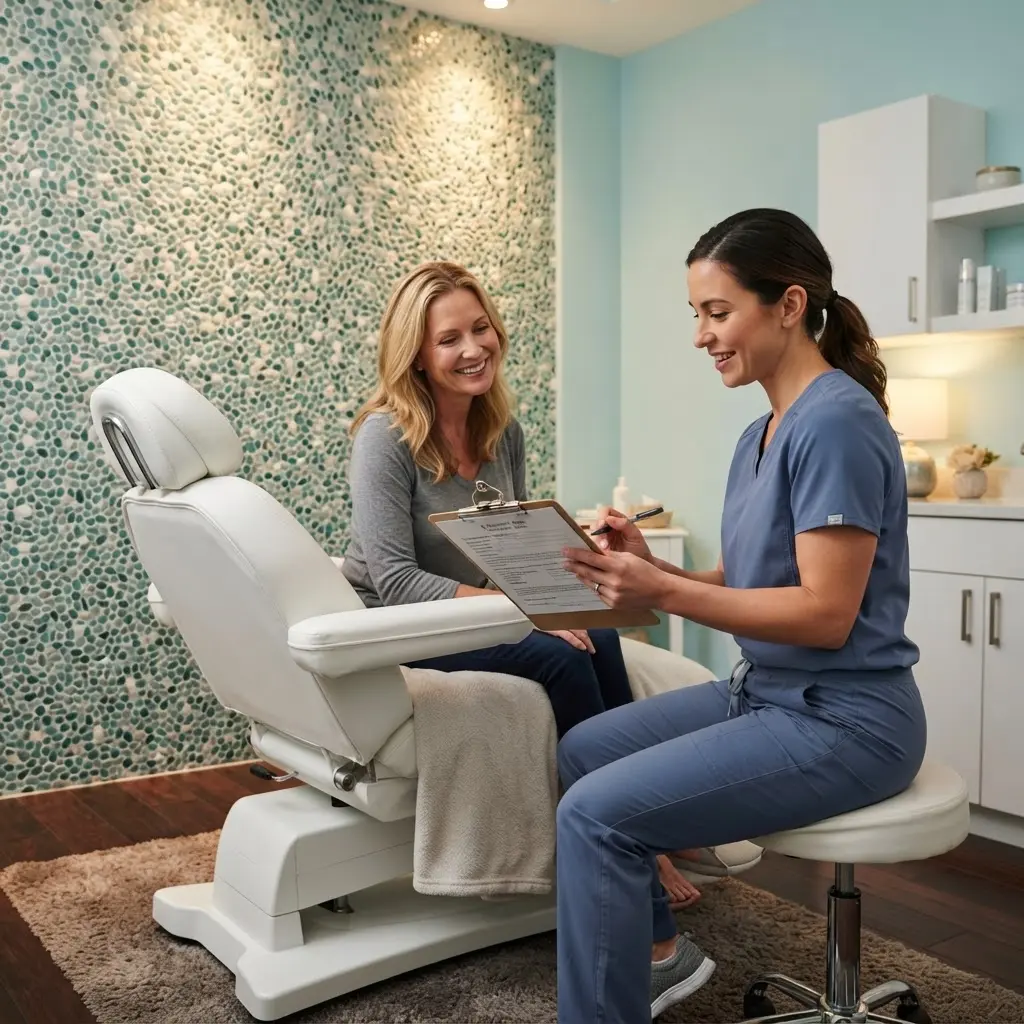
Plan on twenty to 40 minutes. First we’ll take a close look at your spots under light, any pigmented spot that hasn’t been checked for skin cancer gets checked first. Then come cooling gel, eye shields, and a few test pulses to set the energy. Each pulse feels like a hot rubber band snapped against the skin. We start low and build up gradually.
Consult and skin check
We’ll look at every spot under light and ask about sun, self-tanner, medications, and cold sores. Any spot that hasn’t been checked for skin cancer gets checked first.
Prep
We cleanse your skin, then apply cooling gel and eye shields. Numbing is used only if we’ve agreed on it at your consult.
Test pulses and treatment
A few pulses at low energy show how your skin responds, then overlapping pulses across the area. One pass for pigment, one for redness. You’ll feel a hot snap each time.
Before you leave
We remove the gel, apply something cool and then sunscreen, and go over the two key rules: no sun for two weeks, and no picking the flakes.
Results
A predictable timeline
Your spots lighten as they shed, at 1 to 2 weeks. Redness improves over 2 to 4 weeks as the closed vessels fade. Sessions are 3 to 4 weeks apart, and we’ll review the full result a month after the last one. Plan on 3 to 5 sessions, the trials averaged 4.29.
Day 0
Red and warm
Red and warm for a few hours, and a little puffy. We’ll put sunscreen on before you leave.
Days 1 to 7
Coffee-ground flecks
Spots darken to coffee-ground flecks and flake off. Let them shed on their own. Don’t pick.
Weeks 2 to 4
Lighter and calmer
Spots are lighter and redness starts to settle. Time for your next session; redness keeps improving between visits.
One month after last
Review, then maintain
We review the series against your before photos. One or two maintenance sessions a year, plus good sun habits, keep skin clear.
What it costs
Clear pricing, planned by the visit
Your cost depends on the area (face, neck, chest, hands), the number of sessions, and whether you’re having a pigment pass and a redness pass in the same visit. We recommend a series because one visit can’t safely clear widespread sun damage, and the trials averaged more than four sessions.
- The area: face, neck, chest, or hands
- The number of sessions
- A pigment pass and a redness pass in one visit
- Whether you start with a single test session
InMode Lumecca
IPL photofacial
$350
body area, per session
- Recommended series
- 3 to 5, about a month apart
- Season
- October to April
- Consultation
- $50
- Financing
- Affirm, Afterpay, Klarna
Needs two weeks without sun on either side of each session. Much easier in the colder months.
Book your IPL photofacial appointmentSimilar purpose, different options
IPL or something else?
Two other treatments on our menu overlap with IPL, and choosing between them comes down to the color of your concern and the color of your skin.
A chemical peel lifts pigment with acid instead of light. It works on more skin types, flakes for 3 to 7 days instead of darkening for a week, and is the right choice for melasma and blotchy tone. For distinct sun spots on lighter skin, though, IPL clears more: 74.6 to 90 percent of solar lentigines across trials against 12 to 46 percent for TCA peels.
Microneedling with PRP is the one for texture, like acne scars, pores, and fine lines. Needles and your own platelets work in the dermis, with no light and no pigment risk, on any skin type. It won’t change color, though.
| IPL photofacial | Chemical peel | Microneedling with PRP | |
|---|---|---|---|
| Fixes | Distinct sun spots, redness, small veins | Blotchy tone, melasma, acne marks | Texture, pores, acne scars, fine lines |
| Works by | Filtered light heating pigment and vessels | Acid lifting the top layers | Needles and your own platelets, in the dermis |
| Downtime | A week of darkened spots, no peeling | 3 to 7 flaking days for a light peel | Red for 24 to 48 hours |
| Darker skin | Usually no | Light peels, yes | Yes, all skin types |
| Sessions | 3 to 5, about a month apart | 3 to 5 light peels | 3 to 4, about 4 weeks apart |
| Season here | October to April | October to March | Any month |
Fixes
- IPL photofacial
- Distinct sun spots, redness, small veins
- Chemical peel
- Blotchy tone, melasma, acne marks
- Microneedling with PRP
- Texture, pores, acne scars, fine lines
Works by
- IPL photofacial
- Filtered light heating pigment and vessels
- Chemical peel
- Acid lifting the top layers
- Microneedling with PRP
- Needles and your own platelets, in the dermis
Downtime
- IPL photofacial
- A week of darkened spots, no peeling
- Chemical peel
- 3 to 7 flaking days for a light peel
- Microneedling with PRP
- Red for 24 to 48 hours
Darker skin
- IPL photofacial
- Usually no
- Chemical peel
- Light peels, yes
- Microneedling with PRP
- Yes, all skin types
Sessions
- IPL photofacial
- 3 to 5, about a month apart
- Chemical peel
- 3 to 5 light peels
- Microneedling with PRP
- 3 to 4, about 4 weeks apart
Season here
- IPL photofacial
- October to April
- Chemical peel
- October to March
- Microneedling with PRP
- Any month
If your concern is sagging rather than color, none of these three is the right fit. Forma tightens mildly with radiofrequency, and Morpheus8 goes deeper.
Is it right for me?
Who it’s for, and who it isn’t
IPL tends to be a good fit for lighter skin with sun damage or redness, if you’re ready to stay out of the sun for a month around each session. The trials enrolled Fitzpatrick types I to IV, and that’s where we treat.
A good fit for
- Sun spots, freckles, and blotchy sun damage on lighter skin
- Diffuse redness, rosacea flushing, and broken capillaries
- Small facial veins beside the nose and cheeks
- Fitzpatrick types I to IV
Not recommended
- Darker skin types (the light heats the top layer and can burn)
- Tanned skin or self-tanner, or a beach week coming up
- Melasma, IPL can make it worse; a peel fits better
- During pregnancy, or on photosensitizing drugs
IPL platforms are FDA-cleared for specific lesions, not for “rejuvenation.” It won’t work on tanned skin, isn’t for darker skin, isn’t a wrinkle or tightening treatment, and spots can return if sun habits don’t change.
In detail
What it treats
IPL treats concerns by color, brown and red, and offers modest improvement in texture.
Brown. This includes sun spots (solar lentigines, to a dermatologist), freckles, and blotchy sun damage across the cheeks, chest, and backs of the hands. It’s what IPL does best. In a 2025 systematic review of trials, IPL cleared solar lentigines in 74.6 to 90 percent of cases, with less post-treatment darkening than freezing them, per Mardani and colleagues in the Journal of Cosmetic Dermatology.
Red. This includes diffuse redness, rosacea flushing, and broken capillaries beside the nose. The light heats the blood inside the vessel, the vessel closes, and the color fades over a few weeks.
Texture and pores, more modestly. A 2022 systematic review of 16 IPL studies (637 people, skin types I to IV) found improvement in pores and texture along with spots and redness, per Sales and colleagues in Archives of Dermatological Research, though it rated nine of the sixteen studies low quality. Texture improvement is a secondary benefit rather than a main reason to book.
Beyond the face. The neck, chest, and backs of the hands get the same sun exposure and can be treated too.
Those thin red lines on the nose and cheeks are telangiectasias, small dilated vessels near the surface, and they’re named on IPL’s cleared list. Hemoglobin absorbs the light, the vessel seals, and the line fades over 2 to 4 weeks. Leg veins are a different concern that calls for different tools.
How it works
IPL is a flash lamp, not a laser. It sends a broad band of light, roughly 500 to 1,200 nanometers, through a filter that tailors it to the target. Brown pigment and red blood absorb that light more than the skin around them, so they heat up while the surrounding skin mostly doesn’t. Pigment lifts to the surface and sheds over about a week, and treated vessels close and fade, per Goldman and colleagues in Dermatologic Surgery.
The platform on our Arlington Heights menu is InMode Lumecca. IPL platforms are FDA-cleared for specific lesions, not for “rejuvenation.” One current clearance covers benign pigmented lesions, lentigines and melasma among them, and benign vascular lesions “including port wine stains, hemangiomas, angiomas, telangiectasias, rosacea, facial and leg veins,” per the FDA 510(k) summary for the DEKA Lotus. Photofacial is simply a marketing name for treating those lesions across a whole face, and nothing about IPL is FDA-approved.
Melasma is on that list, but IPL isn’t our first choice for it. Melasma can rebound from light, and the American Academy of Dermatology treats light as an add-on for people “already applying medication to their skin and protecting their skin from the sun,” per its melasma treatment page. For melasma, we’ll start you on a medical plan first.
Looking for laser skin rejuvenation?
Many people searching for laser skin rejuvenation want to treat sun spots and redness. For those concerns on lighter skin, IPL is usually the right tool. You may also see it sold as a laser facial, which is misleading on both counts: it isn’t a laser, and it isn’t a facial.
Our one true laser here is the Candela GentleMax Pro, which we use for laser hair removal. Its 1064 nm setting is the safer choice on darker skin. We don’t have a resurfacing laser, so if laser skin rejuvenation means CO2 and a week of raw skin to you, that isn’t something we offer.
Afterwards
Downtime and aftercare
On day 0, expect to be red and warm for a few hours, like a mild sunburn, with a little swelling. Over days 1 to 7, the brown spots get darker, which is expected. Patients on RealSelf call them coffee grounds: dark flecks that flake off over several days. Let them fall away on their own, because flakes pulled early leave marks that outlast the spot. Redness treated at higher settings can leave a small bruise.
Follow these aftercare rules closely, because sun exposure and tanning raise the risk of burns:
- Avoid sun for two weeks before and after each session, and wear sunscreen every morning. A tan absorbs the light in the wrong layer and burns.
- Skip self-tanner before your visit, since it counts as a tan.
- Keep your skincare gentle, and pause retinoids or acids for a few days.
- Skip hot yoga or the sauna on the first day. An ordinary indoor workout is fine after that.
- Makeup can usually go back on the next day.
Spots look darker for 3 to 7 days before they lighten, so avoid scheduling a session in the week before an event or photos.
Why here
Why Arlington Heights
Most sun spots develop from June through September, when people spend the most time outdoors. By October, a summer tan has faded, the spots underneath are more visible, and sun exposure is low enough to treat them safely.
That makes late fall through early spring the best window. Every session needs two weeks without sun on either side, which is much easier in the colder months, when sun exposure is lower. Start in October, and your series can be done by February. If you contact us in summer, we’ll help you plan a series for the fall.
We’re in Suite C of the single-story brown brick building at 3375 N Arlington Heights Rd, about 200 yards south of Dundee, a block and a half south of Buffalo Grove High School. Parking is free in the lot outside. Our medical esthetician performs every IPL treatment. You’ll find directions from the nearby towns on the page for our Arlington Heights office.
Questions
Common questions, answered
A photofacial is intense pulsed light (IPL) applied across the whole face to clear sun spots, freckles, diffuse redness, and small vessels over a series. The name itself is marketing, and the device is an IPL platform that’s FDA-cleared for benign pigmented and vascular lesions.
It doesn’t tighten skin or treat wrinkles, and it’s for lighter skin types. We offer other options for darker skin.
No. A laser emits one wavelength, while IPL is a flash lamp that emits a broad band of light, roughly 500 to 1,200 nanometers, narrowed by filters, which is why one handpiece treats both brown spots and red vessels.
The trade-off is that the broad band isn’t safe on darker or tanned skin.
Yes, for the small red vessels on the nose and cheeks (telangiectasias), which are on IPL’s cleared list. Hemoglobin absorbs the light, the vessel seals, and it fades over 2 to 4 weeks.
Leg veins are a different concern that calls for different tools.
It depends on what you’d like to improve. IPL treats color, like brown spots and redness, on lighter skin. Microneedling treats texture, like pores, scars, and fine lines, on any skin type. Neither one does the other’s job.
If you have both concerns, we’ll plan both treatments, spaced apart, and decide the order at your consult.
It does sting. Each pulse feels like a hot rubber band snapped against the skin, and patients on RealSelf say high settings without numbing “can feel very hot and painful.” That’s why we use cooling gel, start low, and build up gradually. Numbing cream is usually not needed.
No. Treated skin needs two weeks with no sun before and after, and a tan means we can’t treat that day, because the melanin in the top layer absorbs the light and burns. In Arlington Heights, that makes IPL an October to April treatment.
If you truly stay out of the sun all summer, ask about it at your consult.
No, and we don’t treat darker skin types with it. In darker skin, the light is absorbed by pigment in the top layer, which risks burns and lasting dark or light patches.
For pigment in darker skin, we use light chemical peels, and for texture, microneedling with PRP.
Usually 3 to 5, spaced 3 to 4 weeks apart, and we’ll assess your result a month after the last one. The clinical trials averaged 4.29 sessions, with a range of 3 to 7.
After the series, one or two maintenance sessions a year will help keep things clear, or possibly more if you spend summers outdoors.
IPL isn’t reversible, which is why careful screening matters more here than almost anywhere else on our menu. We’ll test a small area first, and if your skin type or a recent tan makes burns or pigment changes likely, we’ll hold off on treatment.
Keep exploring
Related treatments
Related priorities
Chemical peels
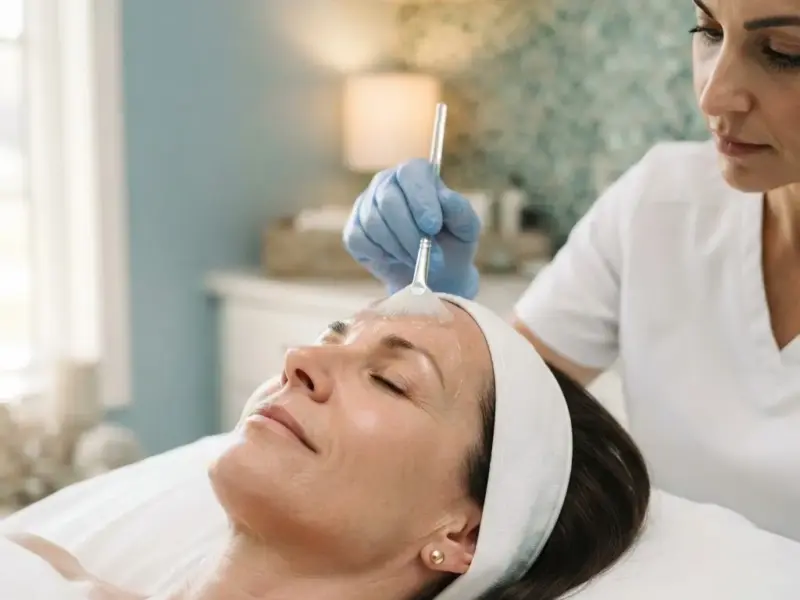
From $275 / peelLight and medium peels that lift sun spots, melasma, acne marks, and dull, rough texture.
Learn more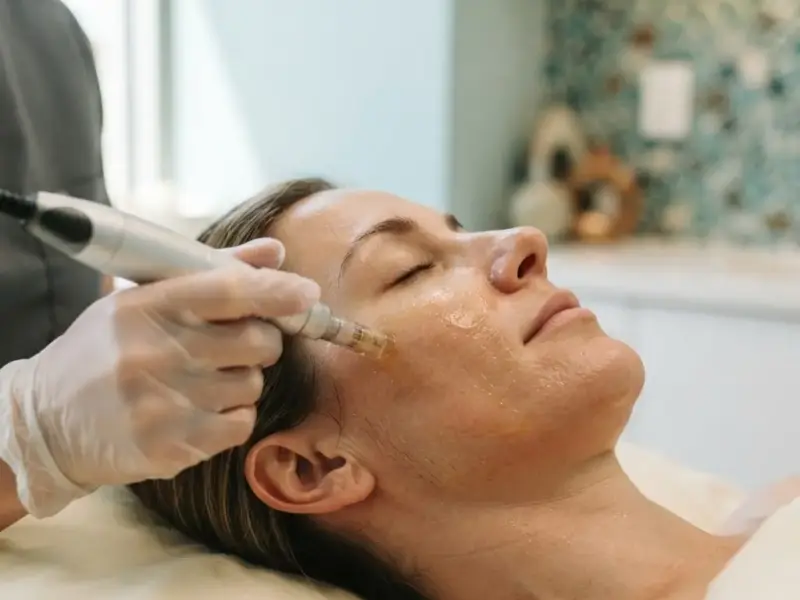
Microneedling with PRP
$499 / sessionMicroneedling paired with your own platelet-rich plasma for acne scars, texture, pores, and tone.
Learn more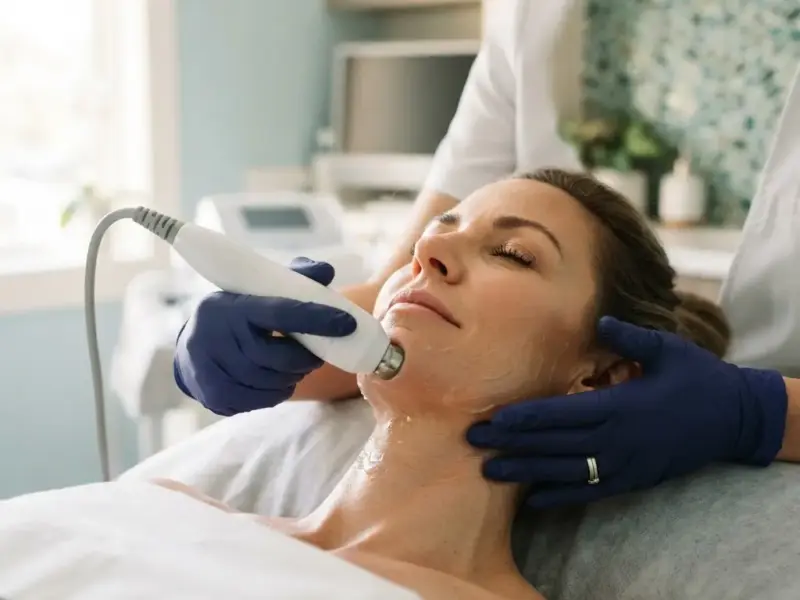
Forma skin firming
$699 / sessionNeedle-free radiofrequency that warms and gently tightens mildly loose skin, with no downtime.
Learn more
Start with a consult
Tell us what you’d like to work on. We’ll assess your skin and goals, walk you through your IPL photofacial options, and give you a clear plan and price before anything begins.
Afterpay and Klarna available at checkout for eligible treatments.